Thursday, June 23, 2011

Clarification on Lat. ā in Early Loanwords into Celtic


On pg. 508, fn. 36 I mention the view of Kenneth Jackson that early Latin loanwords into Celtic accurately reflect the distinction between Latin long and short a and in this regard would preserve evidence for a distinction that the direct Romance tradition never maintains. But reading Loporcaro's masterful essay in the Cambridge History of the Romance Languages has made me realize that I did not cite the crucial evidence and that even that is not very clear. Loporcaro argues convincingly that short vowels were lengthened in stressed open syllables quite early in the proto-Romance period (which means that the rest of fn. 36 also needs some revision).  Hence the cited pair MW caws, OIr. cáisse 'cheese' from Latin cāseus vs. OIr. clann 'family' from Lat. planta is not conclusive evidence for the preservation—a fact which Jackson was well aware of.  What is needed to make the case would be instances of old loans with accented short a in an open syllable represented with a Celtic short a and conversely loans with a long a in a closed syllable represented with a Celtic long a.  Off the top of my head I don't know of any examples of the latter sort, but Russell 1984 cited W ffa < faba and gradd < gradus as examples of the former type.  These, however, are far from sealing the deal.  Note that Irish has grád (o, n. Wb. etc.) with Open Syllable Lengthening and the fairly inexplicable seib for faba (s for f is normal in early loans but the e, which Thurneysen derived from a British pl. *feib < *fabī, is problematic since the word is feminine in British). More research required.

Update: Anders points out the case of Welsh mawrth 'March; Tuesday' <— Lat. ma:rt-. So it is pretty clear that long a in a closed syllables was still distinctive at the time of the Celtic borrowings.  Irish has márta 'March' which the DIL suggest might be a reinterpreted genitive of an i-stem Máirt < Ma:rtius, apparently not actually attested in the meaning March. NYC guy has inspired me to replace the bean picture with a true old world variety, fava beans.

Wednesday, June 22, 2011

Romance Addenda

Two new Romance resources to add to pg. 503:


I haven't used it yet but it looks valuable.

(2) The Cambridge History of the Romance Languages. Vol. 1: Structures, edited by Martin Maiden, John Charles Smith and Adam Ledgeway, Cambridge University Press.

This book offers a pan-Romance perspective on various phonological, morphological, syntactic, pragmatic and lexical processes and patterns.  There are essays by Michele Loporcaro (Syllable, Segment and Prosody, and Phonological Processes), Arnulf Stefenelli (Lexical Stability), and Steven Dworkin (Lexical Change) among others.

Saturday, June 11, 2011

More Verification of Fibula Praenestina

Through the kindness of Professor de Simone:

Friday, June 10, 2011

Missing Reference

Professor Angelo Mercado of Grinnell College alerts me to a missing bibliographical item. On pg. 479 n. 6 I quote Leumann 1968 which is not to be found in the references.  The corresponding datum is:


Leumann, Manu. 1968. "Die Eingliederung entlehnter griechischer Verben ins Latein." Studii Clasice 10:7-12.


Thanks, Angelo!

Wednesday, May 25, 2011

Goth. aleina

On pg. 169 fn. 11 I claim that Go. aleina 'ell' which would normally be phonologized as /ali:na/ is a mistake for *alina with a short medial syllable.  This may indeed be correct but there is some evidence that might support the reality of long i, viz. MW elin 'ellbow' which points to a proto-form *oli:na:. I see there is an article that I will have to read by Dirk Boutkan in Amsterdamer Beiträge zur älteren Germanistik Vol. 41, 1995 that seek to justify *ali:na for all Germanic.


Update: Boutkan makes a good case that the Germanic forms can be derived from a Proto-Germanic *ali:no:. He further argues that the word is a loan from Proto-Celtic *oli:na: which come from *ole:na: a derivative of the hysterokinetic n-stem continued in Gk. ὠλήν (usually ὠλένη). I'm not sure if that is the best way to handle these complicated data.

Sunday, May 22, 2011

Addenda to Bibliography:

To pg. 12 fn. 7 add to the general bibliography for Celtic Ball and Muller 2009 which refers to the second edition of Ball, Martin and Nicole Muller (eds.), The Celtic Languages. Routledge: New York. This edition is a significant improvement over the first in that it has essays covering the Medieval stages of the Celtic languages by David Stifter (Early Irish) and David Willis (Old and Middle Welsh). Joe Eska discusses "The Emergence of the Celtic Languages" and (together with D. Ellis Evans) "Continental Celtic."

Another second edition which should be added is Horrocks 2010 (Geoffrey C. Horrocks, Greek: A History of the Language and Its Speakers. Chichester/Malden, MA: Wiley-Blackwell) replacing Horrocks 1997 on pg. 18, fn. 53. See the review at BMCR.

Monday, May 16, 2011

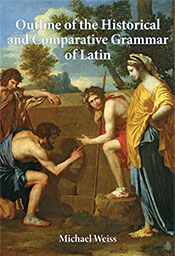
My Cliched Cover Image!

All I can say is "oy!" Strangely, I happen to know to varying degrees the authors of these other books with Poussin on the cover.  Peter Bing was my first Greek teacher and Mario Erasmo was a grad student at Yale when I taught there, though I never taught him. I had no idea that these covers were out there.  I guess the image is just too good to pass up. Sorry, guys! I should have gone with David's Oath of the Horatii.
Brill's Companion to Hellenistic Epigram (Brill's Companions in Classical Studies)